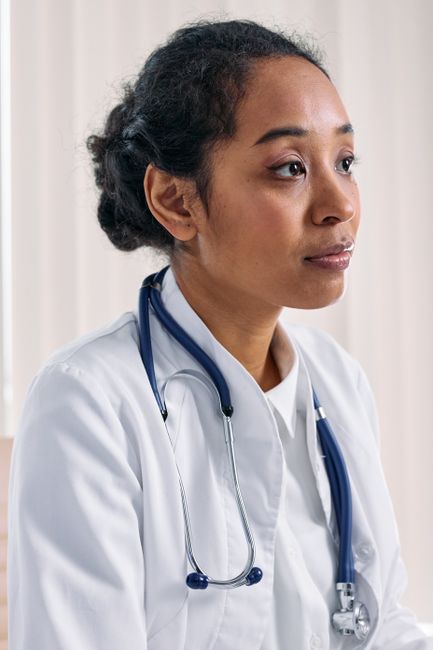
"The note is a first draft. The signature, and the responsibility, are still mine."
Dr. Naomi Okafor is a family physician in a busy primary-care practice, the kind where a full panel and a full inbox arrive on the same morning. She uses an ambient AI scribe that listens during a visit and drafts her clinical note, then produces a plain-language summary the patient takes home. She reviews, edits, and signs every note herself. Here she describes what changed, and what she refuses to hand over.
What did your day look like before you brought AI into it?
Documentation followed me home. I would see patients all day, type fragments into the record between questions, and then finish the real notes at night after my kids were asleep. The clinic has a name for it that most of us know: pajama time. The bigger cost was in the room. When I am typing while a patient describes their symptoms, I am half-listening at best, and they can tell. I missed things because I was watching a screen instead of a face. The notes themselves suffered too. Written hours later from memory and shorthand, they were thinner than the visit deserved, and I would sometimes second-guess a detail I could no longer verify. I was a competent physician spending a large part of my week as a transcriptionist, and neither the patients nor the record were better for it.
What was the first thing you tried, and how did it go?
I started on a deliberately light clinic day, and I was a skeptic. I told a handful of patients that I was testing an assistant that drafts my note, asked for their permission, and let it listen. A structured draft appeared a minute or two after each visit ended. My first reaction was relief, quickly followed by caution. The structure was genuinely useful; it had captured the history and the plan in the right order. It was also uneven. It occasionally phrased something more confidently than the visit warranted, and once it tidied up a detail in a way that changed the meaning slightly. So I kept the draft on one screen and my own memory of the visit on the other and compared them line by line. That first day told me it was worth using, and that it needed a reader.
Concretely, how does it fit into your routine now?
It is part of every visit. When I bring a patient back, I tell them I use an assistant that helps write the note, explain that it listens to our conversation, and get their verbal agreement before anything records. Then I put the laptop aside and actually talk to them. When we finish, a draft note is waiting, along with a plain-language after-visit summary that lists what we discussed, what changed, and what to do next.
I read the note against what I remember, correct anything off, add the reasoning that lives in my head rather than in the transcript, and sign it the same day. The summary I skim for tone and accuracy before it goes to the patient. The workflow only holds because the drafting happens in seconds; the judgment stays where it always was, with me.
Where do you not trust it, and how do you stay accountable?
I do not sign anything I have not read, and I read for the specific ways these tools fail. The published work is honest about this: AI-drafted notes carry fabricated or mis-stated detail more often than notes I write myself. It can record an exam finding I never performed, attribute a statement to the wrong person, or quietly drop a medication change. So I check medications, doses, allergies, and the plan against my own memory on every note, every time.
Confidentiality is the other line I hold. This is protected health information, so I only use a tool covered by a signed business associate agreement, I get the patient's consent before recording, and I can tell them the audio is not kept beyond producing the note. The signature on the chart is mine, and so is the liability. No vendor carries that for me.
Was there a moment it earned its place?
One afternoon I had an older patient with several active problems, a long medication list, and a daughter in the room asking careful questions. Before, a visit like that meant twenty-plus minutes of charting afterward, usually that evening, reconstructing who said what. This time I stayed in the conversation the whole way through. The draft captured the medication reconciliation accurately and preserved a piece of family history I might have compressed to a phrase when writing it up later from memory. The part that stayed with me was the after-visit summary. It laid out the plan in plain language, and the daughter used it to organize her mother's pillbox and follow-up. The note was better and it was done before I left the room. That was the visit where I stopped thinking of it as an experiment.
What would you tell a physician who is skeptical, and how has it changed things?
I would tell them to treat it as a capable first draft, not an authority, and to try it on a slow day where they can check it carefully. The skepticism is the right instinct; keep it and point it at the note before you sign. What it buys back is real. On a typical day I get roughly ninety minutes of charting time returned, and my notes are finished the same day instead of at midnight.
The change patients feel is simpler than any metric. I am looking at them instead of a screen. I catch more of what they say because I am listening rather than typing. The record is fuller because it was written from the conversation itself. I am doing the same medicine I was trained to do, with less of it lost to the keyboard.
In practice
What an ambient scribe changes for a family physician who still reads and signs every note:
- Roughly ninety minutes of charting time returned on a typical day, spent on patients or on getting home at a reasonable hour instead of on after-hours documentation.
- Notes finished the same day, drafted from the visit itself rather than reconstructed from memory and shorthand hours later.
- Eye contact back in the exam room, because the laptop is set aside and the listening happens during the conversation, not through the keyboard.
About Dr. Naomi Okafor
Dr. Naomi Okafor is a family physician in a busy primary-care practice.