4COVR: the PoE camera system built for the small business that outgrew Wi-Fi cameras
4COVR sells complete PoE security systems — NVR, cameras, local storage, and on-device AI detection in one box — sized from 8 to 64 channels, with a dealer program behind them. Here is what the company builds, how it approaches small-business video security, and who it is and is not for.
Most small businesses start their security the same way: one or two Wi-Fi cameras on the front door and the register. It works until it does not. A second entrance goes uncovered, the stockroom gets its own camera on a different app, the parking lot needs something weatherproof, and by the time a manager wants to pull footage of a Tuesday-night incident there are four apps, three subscriptions, and no single timeline to scrub. The camera count grew; the system never did.
4COVR is built for the moment a business realizes it needs a system rather than a pile of cameras. The company sells complete Power-over-Ethernet packages — a network video recorder, a matched set of cameras, a hard drive already installed, and the software to watch it all — sized by channel count from 8 to 64. Everything records locally, the AI detection runs on the recorder, and there is no monthly fee for either.
What 4COVR sells
The product line is organized around the NVR. 4COVR's recorders come in 8-, 16-, 32-, and 64-channel versions with a built-in PoE switch, so each camera plugs straight into the back of the recorder with a single Ethernet cable that carries both power and video. Person, vehicle, and face detection are processed on the NVR chipset, and every system ships with a hard drive installed — 4TB on the 16-camera systems, expandable to two 10TB drives for businesses that want long retention.
The cameras come in four series, each aimed at a different mounting problem. The Armor series is the workhorse PoE IP camera line for general indoor and outdoor coverage. BinSight cameras add active deterrence — spotlights and dual-light night vision — for the spots where you want a person to know they are on camera. DualArc is the 4K 8MP line for entrances and registers where you may need to read a face or a plate. PanoTrak is the pan-tilt-zoom series for parking lots and perimeters where one motorized camera can replace three fixed ones. Resolution runs from 5MP through 4K 8MP to 12MP, in bullet, turret, and IK10 vandal-rated dome housings.
Two pieces of software tie it together. GuardViewer is the iOS and Android app for live view, recorded playback, motion-driven push notifications, and remote system management. GuardStation is the Windows and macOS desktop client for anyone who manages more than one recorder — a franchise owner with three locations, or an office manager who wants a wall monitor showing every camera at once — with multi-site NVR federation, AI-assisted search, and an electronic map view that places each camera on a floor plan. The recorders also accept third-party ONVIF cameras, so a business with existing PoE cameras does not have to throw them away.
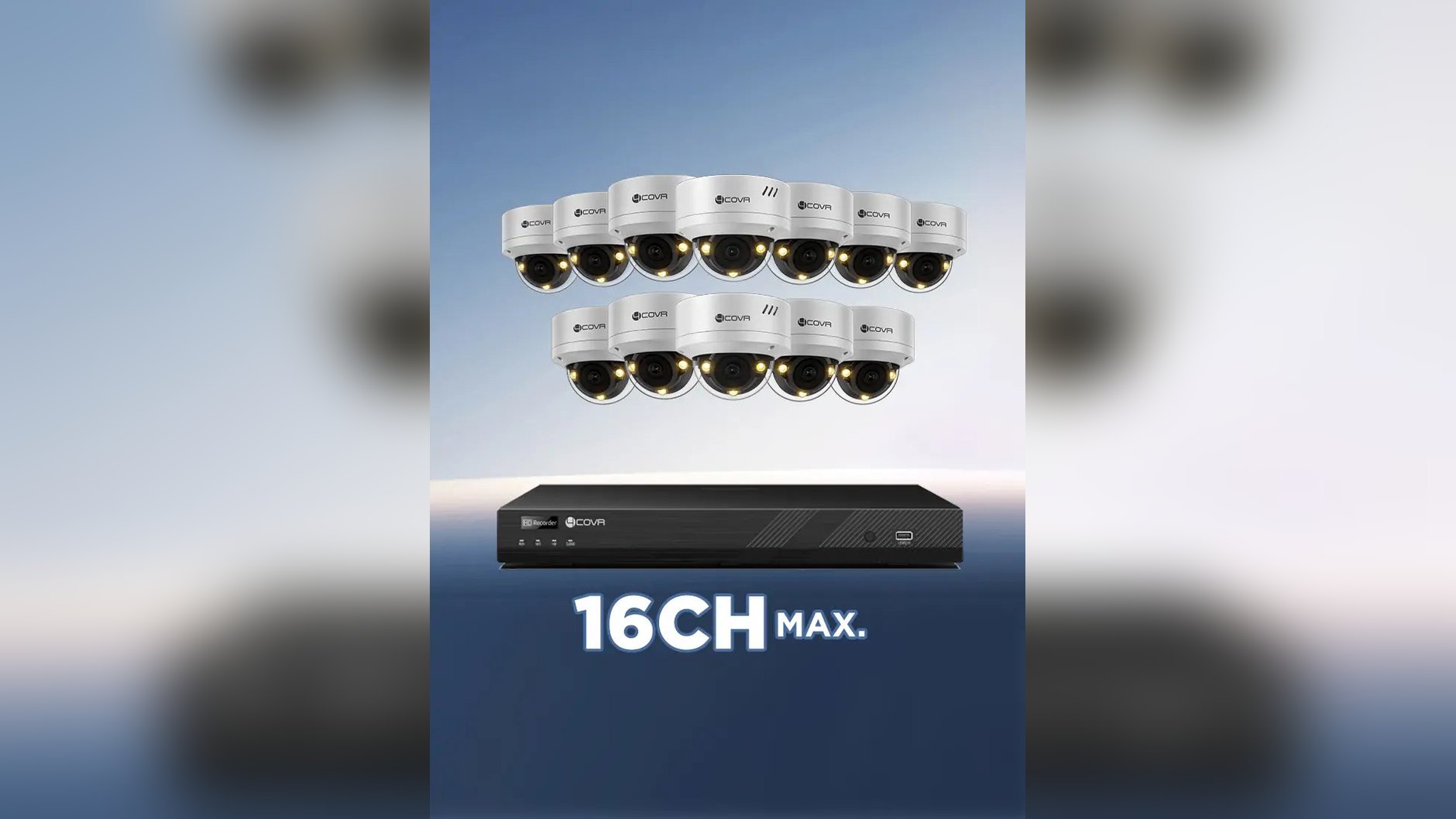
Most buyers never assemble the pieces themselves. 4COVR sells pre-configured bundles — a recorder, a matched camera set, and the drive, factory-tested as one system — organized by channel count, with a featured line of vandal-resistant dome systems for spots where cameras get knocked. The 16-channel collection alone lists sixteen distinct systems: 5MP, 4K 8MP, or 12MP cameras in bullet, turret, dome, or mixed sets, with Smart IR or spotlight night vision, every one with a 4TB drive installed.
Why PoE, and why a system
Wi-Fi cameras are easy to buy and hard to live with at scale. Each one needs power from an outlet, a strong wireless signal, and its own battery or plug; each one also records to its own storage or its own cloud plan. PoE inverts that. One Cat5e or Cat6 cable per camera carries power and data back to the recorder, which means no outlets near the mount, no dropped wireless connections, and one place where all the footage lives.
The cost of that reliability is cabling. Every camera location needs an Ethernet run back to the NVR, and on a finished building that is a day of work for a low-voltage installer. For a business with more than a handful of cameras it is usually the right trade: the cable is the cheap, boring part of a professional install, and once it is in the walls the system stays up through Wi-Fi outages and router swaps.
Sizing: 8, 16, 32, or 64 channels
The channel count is the one decision that is expensive to get wrong, because an NVR cannot grow past the number on the box. 4COVR's own guidance, and ours, is to count the spots you need to cover today and then buy room to grow.
- 8 channels — a single storefront, a small office, or a clinic: front and back door, register, stockroom, a couple of exterior angles.
- 16 channels — the sweet spot for a growing business: a larger retail floor, a restaurant with dining, kitchen, and delivery door, a warehouse with docks and inventory aisles, or an office with reception, hallways, and parking.
- 32 channels — a multi-zone commercial site, a car lot, or a business that wants the parking lot and the perimeter covered as thoroughly as the interior.
- 64 channels — large warehouses, manufacturing floors, campuses, and multi-building facilities that would otherwise need several recorders.
A business that needs six cameras today and buys an 8-channel system has two spare ports. Add a rear entrance and a loading dock next year and it is full; the third camera after that means a second recorder. The 16-channel system is the size most small businesses should be looking at, and it is where 4COVR concentrates its widest range of configurations.
What sets the 4COVR approach apart
Plenty of cameras are sold one at a time, each with its own app and often its own subscription. That model suits a home with two or three of them; it gets unwieldy at the point where a business needs ten. 4COVR is built for that second case, and four choices define its approach.
- A complete system, not a pile of cameras — camera, PoE, NVR, and storage are designed and sold together, so there is one recorder, one timeline, and one app instead of a separate account per camera.
- Channel-based scalability — 8, 16, 32, and 64 channels in one product family, so a business sizes the recorder to the building and adds cameras without changing platforms.
- Business-oriented hardware — IP67 outdoor housings, IK10 vandal-rated domes, 30-meter infrared, spotlight deterrence, and PTZ tracking for lots and perimeters.
- Local recording with AI on the box — 24/7 recording to a drive you own and person, vehicle, and face detection on the recorder, with no cloud plan required for either. Footage stays on-site; the monthly bill is zero.
The company packages all of this for a buyer who has never owned an NVR: pre-matched bundles, a plug-and-play PoE switch inside the recorder, a two-year warranty, and support that answers within 24 hours. That is the gap it is aiming at: the small business that has outgrown standalone cameras but does not want to hire an integrator to get professional coverage.
AI detection that reduces the review, not just the alerts
The practical value of AI in a business camera system is not the notification; it is the search. A 16-camera system recording 24/7 produces hundreds of hours of footage a day. When something happens, the question is whether a manager can find it in five minutes or fifty. 4COVR's recorders classify people, vehicles, and faces as they record, so playback can be filtered to the events that matter — a person at the back door after close, a vehicle in the loading zone on a Sunday — instead of scrubbing continuous video.
Because the detection runs on the recorder rather than in a cloud service, it keeps working when the internet is down and it costs nothing after the purchase. That is the same on-device model we recommend for any business camera, and it is the reason we steer readers away from event-clip battery cameras for anything that matters.
Local recording and what it means for retention
Every 4COVR system records to the hard drive inside the NVR. Footage never leaves the building unless someone exports it, which simplifies the privacy conversation with employees and customers and removes the cloud-storage line from the monthly budget. The trade-off is that retention is bounded by the drive. How many days a 4TB drive holds depends on the number of cameras, their resolution and frame rate, the compression setting, how much motion the scenes contain, and whether you record continuously or on events. Sixteen 4K cameras recording around the clock will fill 4TB in days; the same cameras on event recording at a lower bitrate can stretch to weeks. Businesses with a 30- to 90-day retention policy should plan on a second drive, which the 16-channel recorders support.
Beyond the box: dealers, integrators, and project supply
Not every 4COVR system is bought off the website by the business that will use it. The company runs an authorized dealer program for installers and resellers, with tiered pricing and volume rebates, project registration that protects a dealer's territory and margin on a bid, priority access to pre-sales engineers and product specialists, training, and co-marketing assets. A documentation and download center and a video gallery back the program up.
For distributors and larger projects, 4COVR says it also offers OEM and ODM work — private-label branding, firmware adaptation, and hardware revisions — along with bulk and multi-site project supply: tiered volume pricing, mixed-SKU orders, factory pre-configuration, and staged delivery for rollouts across several locations. For a small business, the practical upshot is that the same system can be bought direct for a single site or through a local installer who handles the cable runs and the commissioning.
Where a 4COVR system fits
- Retail — entrances, checkout, aisles, stockroom, and the parking lot, with spotlight cameras on the exterior to deter after-hours activity.
- Restaurants — front door, dining room, kitchen and service line, and the delivery door where most shrink happens.
- Offices — reception, hallways, server room, and parking, with a desktop client on the office manager's monitor.
- Warehouses and light manufacturing — loading docks, inventory aisles, entrances, and perimeter, where a PTZ camera can sweep a yard.
- Salons, clinics, and service businesses — entrance, reception, customer areas, and the back office, with cameras that stay out of treatment rooms.
- Small commercial properties — shared entrances, common areas, parking, and the exterior of a multi-tenant building.
Who should and should not buy one
A 4COVR system makes sense for a business that needs several fixed cameras, can run Ethernet cable, wants footage kept on-site, expects to add cameras over time, and does not want a monthly bill for recording or detection. It is the right shape of product for the retail, restaurant, office, and warehouse scenarios above; the company's own guide to PoE security camera systems for business walks through the same planning questions from the installer's side.
It is the wrong product for a business that needs one indoor camera, rents a space where it cannot run cable, wants a fully wireless setup, or needs a temporary camera for a job site. Those buyers are better served by a wire-free camera with local storage, which we cover in the roundup. A PoE system is a commitment to cabling, and it only pays off when there are enough cameras to justify the install.
Results in context
The figures in this profile are drawn from 4COVR's published product pages, collection listings, and partner program at the time of writing. Prices and configurations on the collection pages change with promotions and stock; storage capacity and retention depend on how a system is configured; dealer and OEM terms are the company's own description of its programs.
- One product family from 8 to 64 channels, so a business can size the recorder to the building and add cameras without changing platforms.
- Local recording and on-recorder AI detection with no subscription, which is the architecture we recommend for business cameras regardless of brand.
- Four camera series, pre-configured bundles, ONVIF support, and a dealer program, so the same system can be bought direct or installed by a local integrator.
About 4COVR
4COVR designs and manufactures professional-grade PoE video surveillance systems for homes, small businesses, and commercial sites: 8- to 64-channel NVRs, the Armor, BinSight, DualArc, and PanoTrak camera series, pre-configured camera-and-NVR bundles, and the GuardViewer mobile and GuardStation desktop software. Founded in 2017 with an in-house R&D team, the company sells through global distributors, an authorized dealer program, and, since 2026, its own direct-to-consumer store.