GMKtec M5 Ultra Mini PC Review: An 8-Core Ryzen Desktop for Business
A compact eight-core desktop that leans on thread count rather than the latest architecture — here is where its extra cores help a business, and where its older graphics hold it back.
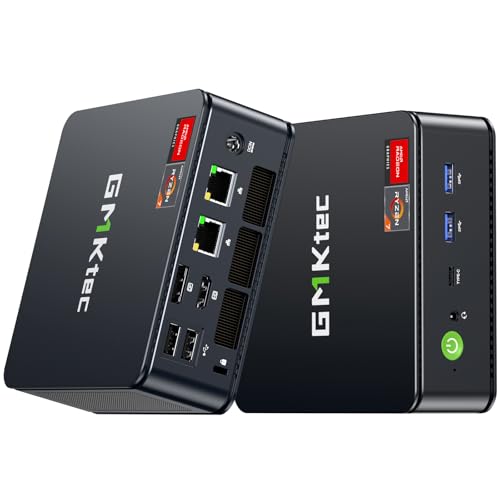
A capable eight-core mini PC for multitasking-heavy offices. Its Ryzen 7 7730U handles many apps at once, but it uses an older architecture and DDR4, so it is about threads, not cutting-edge speed.
Check price on Amazon →| Processor | AMD Ryzen 7 7730U (8-core / 16-thread, Zen 3+, up to 4.5GHz) |
|---|---|
| Graphics | AMD Radeon Graphics (integrated, 8-core iGPU, up to 2000MHz) |
| Memory | 16GB DDR4 (2x8GB), upgradable to 64GB |
| Storage | M.2 2280 PCIe SSD (512GB base), dual-slot, expandable to 8TB |
| Displays | Triple 4K@60Hz |
| Networking | Dual 2.5GbE LAN, Wi-Fi 6E, Bluetooth 5.2 |
| Ports | 2x USB 3.2, 2x USB 2.0, HDMI 2.0, USB-C (PD/DP/data), DisplayPort |
| Warranty | 1-year limited |
The GMKtec M5 Ultra is a compact AMD Ryzen 7 mini PC that trades the newest architecture for a higher core count, and its strength is running many things at once. For a business whose staff keep a dozen apps open across several monitors, those eight cores and sixteen threads keep the machine smooth where a four-core budget box would bog down.
This review covers what the M5 Ultra does well, where its older design and DDR4 memory show their age, and how it compares to the other mini PCs on the same shelf. Every spec below comes from the manufacturer listing.
What the GMKtec M5 Ultra Is — and Who Should Buy It
The GMKtec M5 Ultra is a small-form-factor desktop built around an eight-core AMD Ryzen 7 7730U. It runs like a normal Windows desktop and puts its money into cores and threads rather than the latest chip design, which makes it a multitasking machine first.
It suits businesses where staff run a lot of software at the same time — many browser tabs, background apps, spreadsheets, and video calls — across triple monitors. It is more than a basic front-desk PC needs, and despite the "gaming" branding it is not built for serious 3D or large local AI models, which require a dedicated graphics card it does not have.
- Best for: heavy multitaskers and triple-monitor office desks that keep many apps open
- Also good for: small office servers and network appliances, thanks to dual 2.5GbE ports
- Skip it if: you want the fastest single-app speed, or discrete-GPU power for 3D or local AI
Performance: Eight Cores, Older Architecture
The Ryzen 7 7730U is an eight-core, sixteen-thread processor that excels at doing many things at once. That thread count is its headline advantage over the four- and six-core chips in cheaper mini PCs: background tasks, sync, and open apps have somewhere to run without dragging down whatever is in front of you.
The trade-off is that the 7730U is built on AMD's older Zen 3+ design and a 15W-class mobile power profile, so it is tuned for efficiency rather than peak speed. In practice it feels quick for office work, but a newer chip like the one in GMKtec's own M6 Ultra will pull ahead on single, demanding tasks even with fewer cores. The M5 Ultra's case for a business is breadth of workload, not raw pace.
Graphics and the "Gaming" Label
The M5 Ultra's integrated Radeon graphics are fine for business display work but modest by today's standard, and the "gaming" label oversells them for a professional buyer. They comfortably drive three 4K screens at once and handle 4K video playback and editing, which is the part most offices care about.
For a business audience, the extra graphics headroom only pays off in a narrow band of work — light video editing, GPU-accelerated design tools, and busy multi-monitor setups. For documents, email, and browser apps it makes no visible difference. And for demanding 3D, modern gaming, or running AI models on-device, these integrated graphics are not enough.
- Useful for: triple 4K displays, light video editing, and GPU-accelerated apps
- Not useful for: plain office work, where the graphics headroom goes unused
- Not enough for: serious 3D, modern gaming, or local AI inference
Memory, Storage, and Upgrade Room
The M5 Ultra ships with 16GB of DDR4 and an NVMe SSD, and it keeps its components upgradeable. The memory sits in two accessible slots that accept up to 64GB, and dual M.2 storage slots expand to 8TB, so the machine can grow rather than being retired when a workload gets heavier.
That upgrade path is a genuine business advantage over sealed mini PCs. Because the RAM is not soldered, IT can add capacity later instead of replacing the unit — a meaningful saving across a fleet over three or four years.
Ports, Networking, and Deployment
Connectivity is practical and business-friendly. The M5 Ultra has USB 3.2 and USB 2.0 ports, HDMI 2.0, a full-function USB-C port that carries power, display, and data, a separate DisplayPort, plus Wi-Fi 6E and Bluetooth 5.2.
As with its M6 Ultra sibling, the highlight for IT teams is dual 2.5-gigabit Ethernet. Two fast wired ports let the M5 Ultra work as more than a desktop — a small office server, a software router or firewall, or a homelab node — which broadens where a business can put it. GMKtec's one-year warranty, however, is shorter than the three years some rivals include.
Where the GMKtec M5 Ultra Falls Short
The M5 Ultra's weak points come from its older platform and value-brand support. They do not rule it out, but they explain why it is a multitasking pick rather than an all-around performance leader.
- Older Zen 3+ architecture and DDR4 memory — efficient, but behind newer DDR5 models on speed
- Integrated graphics only — no discrete GPU for 3D, gaming, or local AI
- One-year warranty, shorter than the three years some business-focused rivals offer
- GMKtec is a value brand — support and resale value trail Lenovo, Dell, or HP
Where to buy the GMKtec M5 Ultra Gaming Mini PC Ryzen 7 7730U
A capable eight-core mini PC for multitasking-heavy offices. Its Ryzen 7 7730U handles many apps at once, but it uses an older architecture and DDR4, so it is about threads, not cutting-edge speed.
Check price on Amazon →Alternatives worth comparing
If the GMKtec M5 Ultra Gaming Mini PC Ryzen 7 7730U is not the right fit, these are the other mini pcs ranking alongside it right now.


Frequently Asked Questions
- Yes, particularly for multitasking-heavy work. Its eight-core Ryzen 7 7730U keeps many apps, tabs, and background tasks running smoothly across triple 4K monitors, and dual 2.5GbE ports let it double as a small server. It is more capable than a basic office PC.
- The M5 Ultra has more cores (eight versus six) but uses an older Zen 3+ architecture and DDR4 memory. The M6 Ultra uses a newer Zen 4 chip and faster DDR5, so it is quicker on demanding single tasks. Choose the M5 for broad multitasking, the M6 for peak speed.
- Only small ones, and slowly. It relies on integrated Radeon graphics with no dedicated AI accelerator, so it is not suited to on-device inference. For local AI, pick a mini PC with a discrete GPU or a chip that includes an NPU.
- Up to 64GB. It ships with 16GB of DDR4 in two accessible slots, so you can upgrade memory yourself instead of replacing the machine.
- A one-year limited warranty. That is shorter than the three-year coverage some business-focused mini PCs offer, which matters for a fleet deployment.
Rolling out mini PCs for your business?
Layer3 Labs helps small and mid-size businesses choose, standardize, and deploy the right AI-ready hardware, and the workflows that run on it.
Book a free consultation