GEEKOM A8 Mini PC Review: Ryzen 7 Power in a 0.5-Liter Case
An 8-core Ryzen 7 chip, DDR5 memory upgradeable to 128GB, and a 0.5-liter chassis: here's where the GEEKOM A8 fits in a business, and where it doesn't.
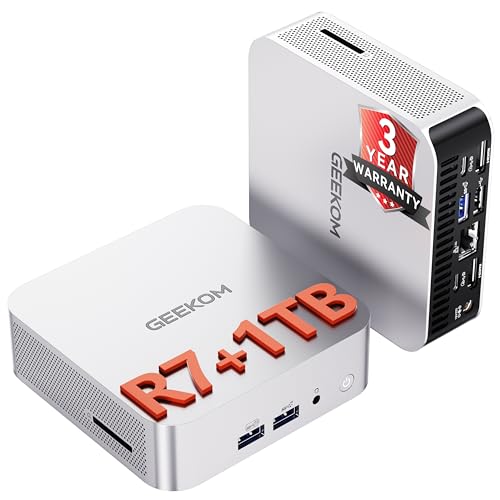
A capable Ryzen 7 mini PC with genuine upgrade room to 128GB of DDR5 and 4TB of storage, built for businesses that need more headroom than a basic office desktop, not for local AI inference or discrete-GPU workloads.
Check price on Amazon →| Processor | AMD Ryzen 7 8745HS |
|---|---|
| Graphics | AMD Radeon 780M (RDNA 3, integrated) |
| Memory | 16GB DDR5, upgradeable to 128GB DDR5 |
| Storage | 1TB PCIe 4.0 NVMe SSD, upgradeable to 4TB |
| Display support | Up to four 4K displays or one 8K display |
| Connectivity | 40Gbps USB4, dual HDMI, USB-C |
| Chassis | 0.5L ultra-compact aluminum case with included VESA mount |
| Cooling | Dual heat pipes with a high-efficiency fan and optimized airflow |
The GEEKOM A8 pairs an AMD Ryzen 7 8745HS processor with 16GB of upgradeable DDR5 memory inside a 0.5-liter aluminum chassis. It targets small and mid-size businesses that want desktop-class performance without a desktop-size footprint, from creative workstations to multi-monitor command desks.
This review covers what those specs mean for daily business use, how the A8 compares to the other mini PCs selling on the same shelf, and where it falls short. Every claim below comes from GEEKOM's own product listing.
What the GEEKOM A8 Is Built For
The GEEKOM A8 is a small-form-factor desktop built around the AMD Ryzen 7 8745HS, an 8-core, 16-thread mobile processor with integrated Radeon 780M graphics. That combination puts it a tier above entry-level mini PCs that rely on Celeron or lower-tier Ryzen chips.
It fits businesses that need more headroom than a basic office desktop: budget video editing, multi-monitor trading or dispatch desks, light AI-assisted creative work, or running a handful of virtual machines. It is not a substitute for a discrete-GPU workstation if the job is heavy 3D rendering or training large models locally.
- Best for: creative studios, multi-monitor command centers, and small-business workstations that need more than basic office power
- Also good for: virtual machines, business databases, and 4K video editing
- Skip it if: you need a discrete GPU for serious 3D work, large local AI models, or gaming at high settings
Performance: What the Ryzen 7 8745HS and Radeon 780M Handle
The Ryzen 7 8745HS is an 8-core, 16-thread processor, giving the A8 more parallel processing headroom than the 4- and 6-core chips found in cheaper mini PCs on the same shelf. That extra core count helps with compiling code, running multiple virtual machines, and multitasking across dozens of browser tabs and business apps at once.
Its Radeon 780M graphics use AMD's RDNA 3 architecture, the same graphics architecture family found in AMD's current discrete cards. GEEKOM's listing points to 4K video editing, digital art, multi-monitor productivity, and AI-assisted creative tools as realistic workloads for the integrated GPU.
Memory and Storage: Real Upgrade Room
The GEEKOM A8 ships with 16GB of DDR5 memory and a 1TB PCIe 4.0 NVMe SSD, and both can grow well past that starting point. GEEKOM lists support for up to 128GB of DDR5 and up to 4TB of SSD storage, a wide upgrade path for a 0.5-liter machine.
That matters for a growing business. Many compact mini PCs solder memory to the board, so the day 16GB stops being enough, the whole unit is done. The A8's upgrade path means a business can buy it for today's workload and add memory or storage later instead of replacing the machine outright.
At Layer3Labs, our own gear-radar routine tracks dozens of mini PC listings across this category every week, and the pattern holds up: DDR5 memory that's actually upgradeable, not soldered, paired with an 8-core chip is still the exception on this shelf, not the rule.
Ports and Display Support for a Multi-monitor Desk
The GEEKOM A8 connects through 40Gbps USB4, giving it enough bandwidth for high-speed external SSDs and docking stations alongside dual HDMI and USB-C outputs. GEEKOM's listing states the A8 can drive up to four 4K displays or a single 8K display from these ports.
That display support is the practical selling point for financial traders, designers, and anyone running a multi-window dashboard setup. A single USB4 connection can also handle a dock, external storage, and a display at the same time, cutting down on cable clutter at a shared desk.
Design: A 0.5-Liter Case Built for Tight Spaces
The GEEKOM A8 packs its Ryzen 7 hardware into a 0.5-liter aluminum chassis, small enough to mount behind a monitor with the included VESA bracket. That footprint frees up desk space in home offices, creative studios, and shared workstations where a full tower isn't practical.
Cooling a Ryzen 7-class chip in that small a case is a real engineering challenge, and GEEKOM addresses it with dual heat pipes, a high-efficiency fan, and tuned airflow. The listing frames this as keeping performance stable during sustained workloads like video exports or code compiles, while running quietly enough for a shared office.
GEEKOM A8 vs the Other Mini PCs on the Shelf
The GEEKOM A8's closest rival on core count is the GMKtec M5 Ultra, which pairs a Ryzen 7 7730U with 32GB of RAM out of the box. The 8745HS in the A8 is a newer chip with RDNA 3 graphics, but the GMKtec ships with double the starting memory, so the better fit depends on whether raw starting RAM or the newer chip and larger upgrade ceiling matters more.
Against the Apple Mac mini M4, the choice comes down to platform. The Mac mini's M4 chip and unified memory deliver strong efficiency and tight iPhone and iPad integration, but its memory and storage are fixed at purchase. The A8 gives up some of that efficiency for a Windows-based machine a business can upgrade for years.
The KAMRUI models — the AK1PLUS, Pinova P1, and Pinova P2 — sit below the A8 on raw power, running Celeron or lower-tier Ryzen chips with DDR4 memory. They're worth a look for basic office tasks where an 8-core processor and DDR5 speed aren't necessary.
Where to buy the GEEKOM A8 Mini PC
A capable Ryzen 7 mini PC with genuine upgrade room to 128GB of DDR5 and 4TB of storage, built for businesses that need more headroom than a basic office desktop, not for local AI inference or discrete-GPU workloads.
Check price on Amazon →Alternatives worth comparing
If the GEEKOM A8 Mini PC is not the right fit, these are the other mini pcs ranking alongside it right now.


Frequently Asked Questions
- Yes, the GEEKOM A8 suits businesses that need more than basic office power. Its 8-core Ryzen 7 8745HS and Radeon 780M graphics handle multitasking, multi-monitor setups, and light creative work in a 0.5-liter case that fits on a crowded desk.
- The Radeon 780M can accelerate some AI-assisted creative tools, but it is integrated graphics, not a discrete GPU. Running large local language models needs dedicated VRAM the A8 does not have, so treat it as a general business machine rather than an AI inference box.
- Up to 128GB of DDR5, according to GEEKOM's listing. It ships with 16GB, giving a business plenty of room to add memory later instead of replacing the machine.
- The A8 ships with a 1TB PCIe 4.0 NVMe SSD and supports upgrades up to 4TB. That's enough headroom for large creative project files or a growing business database without adding external drives.
- Up to four 4K displays or one 8K display, using its dual HDMI and USB-C outputs plus 40Gbps USB4. That makes it a fit for multi-monitor trading desks or design workstations.
- The A8 fits inside a 0.5-liter aluminum chassis and ships with a VESA mount bracket. It can be mounted directly behind a monitor to keep a desk clear.
Rolling out mini PCs for your business?
Layer3 Labs helps small and mid-size businesses choose, standardize, and deploy the right AI-ready hardware, and the workflows that run on it.
Book a free consultation