Which Mac Mini a Small Business Should Buy
Memory is soldered to the chip, so the order page holds the one decision you cannot revisit later.
Most small businesses should order the Mac mini with the M6 chip and 24GB of unified memory. At Layer3Labs, we specify and deploy the desktops that run automated workflows for small teams, and memory is the line on the order page that comes back to bite people.
Apple sells the Mac mini with two chips. The M6 starts at $899 with 16GB of unified memory and runs up to 32GB, and the M5 Pro starts at $1,699 and runs up to 64GB, according to 9to5Mac. Both went up for pre-order on August 25, 2026, with the first orders arriving on September 22.
Unified memory on Apple silicon is part of the chip package and cannot be added afterwards. Storage can be worked around with an external drive. Memory cannot be worked around at all, so it decides whether you are still happy with the machine in year four.
Which Configuration to Order
Order 24GB of unified memory for a general business desktop, 16GB only for a machine that does one narrow job, and 32GB if a local AI model is part of the plan. The chip choice follows from that number rather than the other way round.
The reason 16GB is risky is not today's workload. It is the browser with forty tabs, a video call, a design tool, and a spreadsheet running at once, three years from now, on a machine you cannot upgrade. Paying once for the middle tier buys the years at the end of the machine's life, and a desktop only pays for itself if it reaches them.
Storage is the cheap decision by comparison. The Mac mini takes 256GB to 2TB internally on the M6, and an external Thunderbolt drive fixes a shortfall for a fraction of what Apple charges per gigabyte. Buy less storage than you think and more memory than you think.
- 16GB: a single-purpose machine. A reception desk, a point of sale, a screen driver in a meeting room.
- 24GB: the default office desktop. Browser, calls, spreadsheets, design work, all at once, for years.
- 32GB: the same, plus a local AI model running alongside it.
- 64GB: only on the M5 Pro, and only when the model size demands it.
The 32GB Ceiling Decides More Than the Chip Does
The M6 stops at 32GB of unified memory, and there is no M6 Pro to step up to. The larger Mac mini uses the previous generation M5 Pro, which reaches 64GB and 307GB/s of memory bandwidth against up to 170GB/s on the M6, per Apple's Mac mini specifications.
That detail changes the shape of the buying decision. Going past 32GB is not a small upcharge on the same machine. It is a jump to a different chip generation at $1,699 before options, which is nearly double the entry price for a business that only needed a bigger memory pool.
For ordinary office work the ceiling never comes up. It comes up the moment somebody wants to run a model past the 30-billion-parameter class on the desk, because a 70-billion-parameter model at 4-bit quantization needs around 35GB before you account for context. Decide whether that is your plan before you pick a chip, not after.
- M6: 16GB to 32GB and up to 170GB/s, on a 12-core CPU and 12-core GPU. That covers any office workload, plus a 13-billion-parameter local model with a full context window or a 30-billion-parameter one on a shorter context.
- M5 Pro: 24GB to 64GB and 307GB/s, on up to an 18-core CPU and 20-core GPU, and the only Mac mini that holds a 70-billion-parameter model.
- No M6 Pro exists in this lineup, so the memory step above 32GB moves you back a chip generation.
One Machine per Desk, or One Shared Box
Buy one Mac mini per person for normal work, and add one shared machine only if you are running a local AI model or an always-on service. Splitting a single desktop between two people who both need it during business hours never works, whatever the machine.
The shared box is a different animal. A Mac mini with a large memory configuration, left running with a model server listening on the office network, answers for everyone else's laptops. That pattern lets you overbuy memory once instead of on every desk, which is the only way the 32GB upcharge pays for itself across a team.
In the automations we run for small business clients, the shared machine tends to accumulate jobs nobody documented. A scheduled export here, a scraper there, a model endpoint three people depend on. Write down what runs on it from day one, because the alternative is discovering the list during an outage.
- Per desk: order the memory each person's own workload needs, usually 24GB.
- Shared: one machine with the largest memory you will pay for, kept on and managed.
- Never: two people time-sharing one desktop during the same working hours.
What a Mac Mini Replaces on a Small Business Desk
A Mac mini replaces a tower, and in a lot of offices it also replaces a docking station. It measures 2.0 by 5.0 by 5.0 inches and weighs about a pound and a half, so it mounts behind a monitor and disappears (Apple).
The port set does the docking job on its own. Three Thunderbolt 4 ports, HDMI, 2.5Gb Ethernet with a 10Gb option, plus two USB-C ports and a headphone jack on the front, per Apple's specifications. A desk that previously needed a laptop, a dock, and a cable nest needs the Mac mini and one monitor cable.
What it does not replace is a laptop for anyone who works away from the office. The Mac mini has no screen, no keyboard, and no battery, so a hybrid worker ends up owning both. That is a real cost, and it is the most common reason a Mac mini turns out to be the wrong answer for a team that thought it was the cheap one.
What It Costs after the $899
The entry price buys a computer and nothing you can look at or type on. Budget a monitor, a keyboard, a mouse, and a cable before comparing the Mac mini to an all-in-one or a laptop, because those four items routinely add a few hundred dollars per desk.
The second line is memory. Moving from the 16GB base to 24GB or 32GB adds a few hundred dollars to the advertised price, and it is the upgrade worth paying for. The third line is management, if the machine belongs to an employee rather than the owner.
Set against that, the running costs are genuinely low. A Mac mini idles quietly, draws little power, and has no fan noise to speak of in an ordinary office, so a machine left on all year is not a meaningful line on the electricity bill. Over a four-year life the purchase price dominates, which is another argument for buying the memory tier once and keeping the machine longer.
- Monitor, keyboard, mouse, and cable: not included, and needed on day one.
- Memory upgrade: the one option that cannot be added later.
- Device management: a per-device subscription once an employee uses the machine.
- Power and noise: low enough that leaving it running is a reasonable default.
Three Displays Is the Hard Limit
The Mac mini drives up to three external displays, and that number does not change with a bigger memory configuration (Apple). Three covers almost every business desk, and it stops short of the trading-desk and video-wall setups that occasionally show up in a finance or operations team.
Check the count against the way the desk is actually used, not the way it is drawn. A person on two monitors plus a wall-mounted screen for a dashboard has already used all three, and adding a fourth means a second machine rather than an adapter.
Any monitor with an HDMI or USB-C input works. You do not need an Apple display. The HDMI port and the three Thunderbolt ports between them cover almost everything already on a business desk.
Who Should Buy a Windows Mini PC Instead
An office whose core software only runs on Windows should buy a Windows mini PC, not a Mac mini. Practice-management software, older accounting packages, and industry-specific tools are the usual culprits, and running them through virtualization means a Windows licence, a virtualization licence, and a support path with two vendors in it.
Teams that replace hardware often should also look elsewhere. Memory and storage are soldered on the Mac mini, so a machine that no longer fits the job gets sold rather than upgraded. A GEEKOM, Beelink, or ASUS mini PC with sockets in it can take more memory in three years for the price of a dinner.
The third case is a business that has standardized on Windows device management and has nobody who knows Apple tooling. Adding one Mac to a fleet of Windows machines adds a second management system, a second patching process, and a second set of questions when something breaks.
What Would Change This Recommendation
Two things would move the answer off 24GB on the M6. The first is a price move on memory. If Apple narrows the gap between the 32GB M6 and the 64GB M5 Pro, the larger machine becomes the sensible shared box for any team running local models, and the M6 goes back to being a per-desk machine only.
The second is an M6 Pro. Apple currently pairs the new chip with the previous generation's Pro tier, and a Pro version of the M6 with more than 32GB would remove the awkward step in the middle of the lineup. Until that ships, a business that needs 64GB is choosing between an older chip and a different machine.
If you already know the largest model you want to run, do the memory arithmetic before you order rather than after. Our local AI hardware calculator turns that model into the memory number, and the number tells you which Mac mini a small business should buy.
What to Buy
Here are the machines this page is about, with our full review of each and a link to the current listing. We have written up every one of them in depth, so the table is a shortcut rather than the whole argument: read the review before you order, because which Mac mini a small business buys is a decision you live with for years.
| Machine | Best for | Our review | Buy |
|---|---|---|---|
| Apple Mac mini (M6, 2026) | The current Mac mini. Our pick for a general business desk at 24GB of unified memory. | Read the review | Check price on Amazon |
| Apple Mac mini (M4) | The 2024 M4 machine. Still does ordinary office work, and the cheaper answer for a single-purpose desk. | Read the review | Check price on Amazon |
| GEEKOM A8 Mini PC | The Windows alternative when line-of-business software will not run on macOS. | Read the review | Check price on Amazon |

The current Mac mini. Our pick for a general business desk at 24GB of unified memory.
View on Amazon →
The 2024 M4 machine. Still does ordinary office work, and the cheaper answer for a single-purpose desk.
View on Amazon →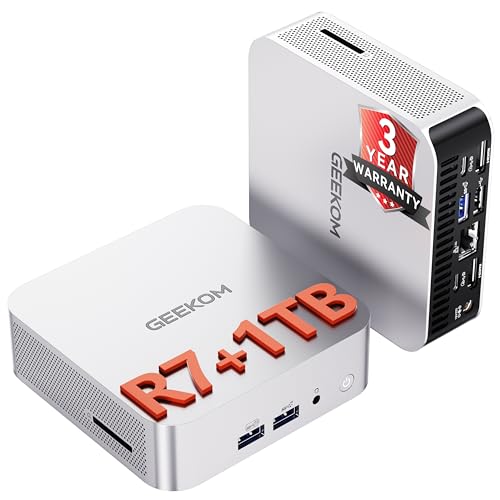
The Windows alternative when line-of-business software will not run on macOS.
View on Amazon →Frequently Asked Questions
- Yes, for a business already comfortable on macOS or one with no Windows-only software to run. It is small, quiet, and cheap to keep running, and it does the work of a tower and a docking station at once. The catch is that memory is fixed at purchase, so a machine ordered too small stays too small for its whole life.
- 24GB, for any machine one person uses all day. The 16GB base configuration handles today's work and leaves nothing spare for the browser, the video call, and the design tool running together in year three. Memory on Apple silicon is soldered to the chip package and cannot be added later, so the upgrade only exists on the order page.
- The M6 Mac mini starts at $899 and the M5 Pro at $1,699, per 9to5Mac. Neither price includes a monitor, keyboard, or mouse, and the memory upgrade most businesses should take pushes the configured price above the advertised one. Check current configurations on Apple's Mac mini order page before budgeting.
- One per person doing full-time work on it, plus one shared machine if you run a local AI model or an always-on service. Two people cannot share a single desktop during the same working hours. The shared box is the only case where paying for the largest memory tier makes sense, because one machine then serves the whole office.
- Only for someone who works in one place. The Mac mini has no screen, keyboard, or battery, so a person who works from home some days ends up owning a laptop as well. For a fixed desk it is the better machine, since the same money buys more computer than a portable one does.
- It depends on how old the M4 machines are and whether local AI is on the roadmap. The M6 adds memory bandwidth, a dual 16-core Neural Engine, and 2.5Gb Ethernet, and the M4 fleet already on desks still does ordinary office work fine. We work through that decision in Mac mini M6 vs M4.
Buy the Mac mini configuration your workflows need
At Layer3Labs, we build and run the automated systems these desktops end up hosting. Tell us what your team does on the machines, and we will tell you which configuration to order and how many.
Book a Consultation