Best Conference Speakerphones for Business in 2026
A good speakerphone makes everyone at the table sound like they are in the room. Here are the pucks worth buying, from home office to conference room.
The best conference speakerphone for most people is the Jabra Speak2 55 — it pairs strong full-duplex audio with a noise-cancelling mic array, works over USB or Bluetooth, and comes in Teams- and Zoom-certified versions. We tested every speakerphone on this list as the call device for a home office or a small conference room. For a small conference room, step up to the Jabra Speak2 75 or a pairable Poly Sync 40. On a tight budget, the Anker PowerConf S3 covers a home office for far less.
This guide ranks the conference speakerphones worth buying in 2026, by use case: home office, small conference room, travel, and budget. We focus on what actually changes a call — mic pickup radius, full-duplex audio (both sides can talk at once), platform certification, and how the device connects. We also cover when a speakerphone stops being enough and a conference room microphone system takes over.
How We Tested
- We took everyday calls on each speakerphone, from a home-office desk to a small conference table.
- We checked mic pickup across the table, full-duplex audio and how each one handled echo and noise.
- We judged setup, connection options and certification for platforms like Teams and Zoom.
The Best Conference Speakerphones, Ranked

Why we picked it: In our testing its mic clarity was excellent for the size, and it was light enough to pack for travel.
Who it's for: Remote workers and home offices taking daily calls from a desk.
The downside: Its speaker is sized for one to four people, so a full room needs the Speak2 75 or a Poly Sync 40.
View on Amazon →- 4-mic beamforming array with noise cancellation
- Full-duplex audio
- USB, Bluetooth, or Jabra Link 380 dongle
- Teams / UC certified variants
- Excellent mic clarity for the size
- Works wired or wireless
- Light enough to travel
- Speaker is sized for 1–4 people, not a room
- Dongle sold with specific bundles only
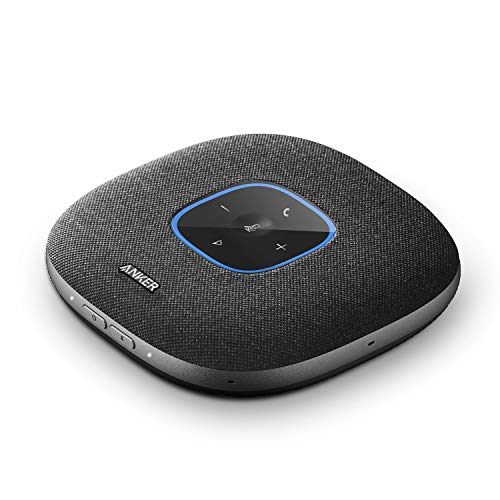
Why we picked it: In our testing it handled home-office calls well for the money, and setup over Bluetooth or USB-C was simple.
Who it's for: Home offices and small huddle desks on a budget.
The downside: It has no Teams or Zoom certification, and its software features are basic.
View on Amazon →- 6-microphone array with echo cancellation
- Bluetooth + USB-C
- Long battery life for all-day calls
- Best for 1–4 people
- Very strong price-to-performance
- Good battery
- Simple setup
- No Teams/Zoom certification
- Software features are basic

Why we picked it: In our testing its speaker had the volume for a shared room, and its rugged build was easy to carry from room to room.
Who it's for: Small conference rooms that want to put off buying an installed room system.
The downside: It is bulkier than desk pucks and costs more than most speakerphones.
View on Amazon →- Multi-microphone array with noise reduction
- Two units can be paired for larger tables
- USB-A/USB-C + Bluetooth
- Teams / Zoom certified variants
- Room-grade speaker volume
- Pairable for bigger tables
- Rugged, portable build
- Bulkier than desk pucks
- Premium price for the category

Why we picked it: It had the best audio quality of any portable puck we tested, and it doubled as a music speaker between calls.
Who it's for: Small meeting rooms that want the strongest single-puck option, certified for Teams, Zoom or Google Meet.
The downside: It carries a premium price and is more than a solo desk caller needs.
View on Amazon →- Large full-range speaker
- 4 noise-cancelling mics + voice normalization
- USB, Bluetooth, or Link 380 dongle
- Certified for major meeting platforms
- Best audio quality in a portable puck
- Evens out quiet talkers
- Doubles as a music speaker
- Premium price for the category
- Overkill for solo desk calls
Why we picked it: In our testing it reproduced voices very naturally, and the dongle connection stayed reliable.
Who it's for: Small-to-mid rooms that run on Microsoft Teams, where the Expand 40T adds a dedicated Teams button.
The downside: Setup is less consumer-friendly than on the Jabra pucks, and you'll find fewer retail bundles.
View on Amazon →- Beamforming mic array tuned for speech
- USB-C wired + Bluetooth via BTD 800 dongle
- Expand 40T: Teams-certified with Teams button
- Best for small-to-mid rooms
- Very natural voice reproduction
- Reliable dongle connection
- Solid build quality
- Less consumer-friendly setup
- Fewer retail bundles than Jabra

Why we picked it: In our testing it beat a laptop mic for very little money, and its compact body fit easily on a huddle-room table.
Who it's for: Offices that want a cheap speakerphone in every huddle space.
The downside: Mic pickup gets weaker at distance, and it has no platform certification.
View on Amazon →- Noise reduction with voice activation
- USB + Bluetooth + optional dongle
- Two units can be daisy-chained
- Best for 1–4 people on a budget
- Very affordable
- Daisy-chain option at a budget price
- Compact
- Mic pickup weaker at distance
- No platform certification
Conference speakerphones at a glance
| Speakerphone | Best for | Connection | Room size |
|---|---|---|---|
| Jabra Speak2 55 | Home office | USB / Bluetooth / dongle | 1–4 people |
| Anker PowerConf S3 | Value pick | USB-C / Bluetooth | 1–4 people |
| Poly Sync 40 | Small conference room | USB / Bluetooth, pairable | 4–8 people |
| Jabra Speak2 75 | Premium small room | USB / Bluetooth / dongle | 2–6 people |
| EPOS Expand 40 | Teams-first rooms | USB-C / BTD 800 dongle | 3–8 people |
| eMeet Luna | Budget | USB / Bluetooth, chainable | 1–4 people |
Best Speaker for Remote Workers
The Jabra Speak2 55 is the best speaker for remote workers taking daily desk calls, while the Anker PowerConf S3 is the best conference speaker on a tight budget. A speakerphone is usually the biggest audio upgrade over a laptop mic. The Jabra Speak2 55 features four beamforming mics with noise cancellation, full-duplex audio, and Teams- and UC-certified versions.
Hardware connections include USB, Bluetooth, or an optional Link 380 dongle. Native laptop Bluetooth can drop to a low-quality hands-free codec when the mic is active, which connecting over USB or the Link 380 dongle avoids. You can see how the hardware performs in our Jabra Speak2 55 vs Poly Sync 20+ comparison, or check the step-up model in our Jabra Speak2 75 review.
The Anker PowerConf S3 is far cheaper than enterprise brands, offering a six-mic array, echo cancellation, long battery life, and Bluetooth or USB-C pairing without platform certification. The eMeet Luna is the cheapest way to stop using a laptop mic with USB and Bluetooth support, though its audio quality trails the others in our eMeet Luna review. For larger spaces, the crossover between a speakerphone and a room system sits at roughly eight to ten seats.
How to Choose a Conference Speakerphone
Start with two questions: how many people sit around the device, and what does it plug into? Those answers decide the mic pickup radius you need and whether USB, Bluetooth, or a dongle is the right connection.
- Pickup radius — Desk pucks hear people clearly within a few feet. For a table of six or more, you need a room-class unit (Poly Sync 40, Speak2 75) or two paired units.
- USB vs Bluetooth vs dongle — USB is the most reliable. A dedicated dongle (Jabra Link 380, EPOS BTD 800) is nearly as good. Native laptop Bluetooth is the weakest link: when the mic is active, many laptops drop to a low-quality hands-free codec, so your audio degrades exactly when the call starts.
- Platform certification — Teams- and Zoom-certified variants are tested end to end, and certification often gates real features: the dedicated Teams button, LED call status, and platform-tuned firmware only ship on the certified SKU.
- Daisy-chaining — Some models (Poly Sync 40, eMeet Luna) link two units to cover a longer table. The practical limit is two; past that, move to a room microphone system.
- Battery — If the device roams between rooms, check talk-time. Wired desk use makes battery irrelevant.
Speakerphone vs Conference Room Microphone System
A speakerphone is a single self-contained puck: mics, speaker, and processing in one box you can move between rooms. A conference room microphone system is installed gear — ceiling or table mic arrays wired into a room processor or video bar — that covers the whole space evenly.
The crossover point is roughly eight to ten seats. Below that, one or two good pucks cover the table for a fraction of the cost. Above it, people at the far end start sounding distant no matter how good the puck is, and an installed mic array (or a video bar with expansion mics) wins. Rooms with hard walls and glass also favor installed systems, because ceiling arrays handle echo better than a table puck can.
Frequently Asked Questions
- The Poly Sync 40 is the best speakerphone for a small conference room — its speaker and mic array are sized for a table of four to eight, and you can pair two units to stretch coverage. The Jabra Speak2 75 is the strongest single-puck alternative, with voice normalization that balances loud and quiet talkers.
- The Jabra Speak2 55 is the best conference speakerphone for most people, pairing full-duplex audio with noise-cancelling mics and Bluetooth connectivity. For small conference rooms, the Poly Sync 40 is the runner-up. Keep in mind that native laptop Bluetooth often degrades audio by dropping to a low-quality hands-free codec when the mic is active, which using USB or a vendor dongle avoids.
- Yes. Every speakerphone in this guide works with Microsoft Teams, Zoom, and Google Meet as a standard audio device. For the best experience, buy the certified variant for your platform — certified models are tested end to end and often add a dedicated Teams button and call-status LEDs. Also prefer USB or the vendor dongle over native laptop Bluetooth, which can reduce mic quality mid-call.
- Yes, and it is usually the single biggest audio upgrade you can make. Laptop mics sit next to the fan and keyboard and point sideways at you. A speakerphone puts a multi-mic beamforming array pointed at the talkers, adds echo cancellation, and supports full-duplex audio so both sides can speak at once without cutting out.
- Some models support it. The Poly Sync 40 and eMeet Luna can each link two units to cover a longer table, which roughly doubles mic reach. Two units is the practical ceiling for pucks — if a room needs more than that, an installed conference room microphone system or a video bar with expansion mics is the better spend.
Upgrading your meeting audio?
Layer3 Labs helps small and mid-size businesses choose and deploy meeting-room gear — speakerphones, cameras, and AI note-taking — so hybrid calls just work. We map the right devices to your rooms, platforms, and budget.
Book a free consultation