Logitech H390 Review: The Boring, Reliable Call Headset
A wired USB-A stereo headset with a noise-canceling boom mic and in-line controls — the option most IT teams reach for first, for good reasons.

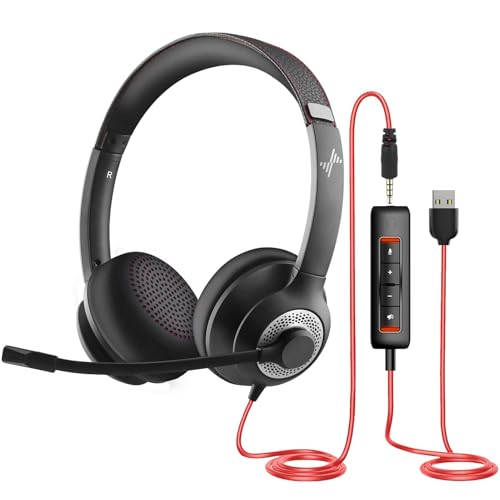
A no-nonsense wired USB-A headset for daily video calls and meetings. It is a wired product, not wireless, and that is exactly what makes it reliable — plug it in and it works.
Check price on Amazon →| Connection | Wired USB-A (plug-and-play) |
|---|---|
| Cable length | 6.23 ft (1.9 m) |
| Microphone | Rotating noise-canceling boom |
| Audio | Digital stereo, fine-tuned drivers |
| Controls | In-line volume and mute |
| Ear cushions | Leatherette, swivel-mounted, adjustable headband |
| Compatibility | Windows, macOS, Chromebook (Works With Chromebook certified) |
| Packaging | FSC-certified paper |
The Logitech H390 is a wired USB-A stereo headset built for people who spend their day on video calls. It is the sort of headset that appears in office supply orders and IT stockrooms in bulk, because it does one thing — plug in, sound clear, stay comfortable — without asking anyone to pair, charge, or update it.
This review covers what the H390 actually does, where a wired headset limits you, and where it fits in a lineup that includes its USB-C sibling and Logitech's own Bluetooth models. Every spec here is from Logitech's listing.
What the H390 Is — and Who Should Buy It
The H390 is a wired, over-the-head USB headset with a boom microphone that swivels down for calls and tucks up when you are done. Despite living in Amazon's Wireless Headsets rankings, it is not a wireless headset — the connection is a USB-A cable to your computer, and that is a feature, not a bug.
It is aimed at people who take calls and video meetings at a desk all day. It removes every failure mode a wireless headset can have: no pairing, no charging, no Bluetooth drops, no firmware updates. For most knowledge workers, a laptop stand and a wired headset covers 90% of the job.
- Best for: daily Zoom, Teams, Google Meet, and Slack huddles at a desk
- Also good for: call-center-style seats, front-desk phones running through a PC, and hot-desks where a wired headset stays put
- Skip it if: you need to leave your desk mid-call, or you only have USB-C ports (get the H391)
Sound and Mic: Clear Enough for Meetings
Logitech's fine-tuned drivers give the H390 a clean, mid-forward sound that flatters voices, which is what a meeting headset should do. It is not a music-first headphone, and no reasonable buyer at this price expects one. Everything you need to hear a colleague, a Loom, or a podcast comes through cleanly.
The rotating noise-canceling boom microphone is the piece that actually earns its keep. It sits close to your mouth on a stiff arm, so it picks up your voice and rejects most of the room. When you are done, the boom rotates up and out of the way, which is the small ergonomic detail that makes a wired headset livable.
Comfort for All-day Wear
The H390 uses leatherette ear cushions on swivel-mounted cups and an adjustable padded headband. That combination is standard for a reason — it distributes weight, seals reasonably around the ear, and wipes clean between users.
For all-day wear, leatherette runs warmer than fabric earpads, so if you are in a hot office you may want to take breaks. But the H390 is light enough and clamps softly enough that most people forget it is there for hours at a time.
Connectivity and Compatibility
This is a USB-A headset. You plug it into a full-size USB port and it works immediately — no drivers, no app, no pairing. It is Works-With-Chromebook certified, and it behaves the same on Windows and macOS.
The 6.23 ft cable is long enough to run from a desktop tower on the floor up to your head. Inline volume and mute controls sit within reach on the cable, which is the fastest possible way to mute yourself when a dog barks.
Where the H390 Falls Short
The H390's limits are the ordinary limits of a wired, entry-level USB headset.
- It is wired — you cannot walk away from your desk mid-call, and the cable adds one more thing on the desk
- USB-A only — no help if your laptop is USB-C or Thunderbolt only
- No app — you cannot tune EQ, sidetone, or mic level the way you can on Logitech's Zone models
- Leatherette pads warm up over long sessions in a hot room
H390 vs the Alternatives
Against the other headsets ranked alongside it, the H390 is the safe default. The Logitech H391 is the same product with a USB-C plug for newer laptops. The Logitech Zone 300 is Logitech's genuinely Bluetooth wireless option if you need to walk around. Cheaper JIAMQISHI models add a 3.5mm plug and lower price but no brand-support story, and the Jabra Evolve 10 is a comparably-priced wired alternative with Jabra's enterprise pedigree.
For most single-buyers or small teams standardizing on wired headsets, the H390 is the boring, correct choice. The full comparison is below.
Where to buy the Logitech H390 USB Headset
A no-nonsense wired USB-A headset for daily video calls and meetings. It is a wired product, not wireless, and that is exactly what makes it reliable — plug it in and it works.
Check price on Amazon →Alternatives worth comparing
If the Logitech H390 USB Headset is not the right fit, these are the other wireless headsets ranking alongside it right now.


Frequently Asked Questions
- No. Despite its position in Amazon's Wireless Headsets category, the H390 is a wired USB-A headset. It connects with a 6.23 ft cable and does not use Bluetooth.
- Yes. The H390 is USB plug-and-play and works on Windows, macOS, and Chromebooks with no drivers to install.
- Not directly. The H390 uses USB-A. If your laptop only has USB-C ports, get the Logitech H391 — it is the same headset with a USB-C connector — rather than adding a dongle.
- Yes. Its rotating noise-canceling boom mic is designed for voice calls, and in-line controls let you mute and adjust volume without touching the app.
- It is a noise-canceling boom mic, not full active noise cancellation on the audio. It rejects most steady room noise near your mouth, which is what call software needs to keep your voice clean.
Standardizing headsets for your team?
Layer3 Labs helps small and mid-size businesses choose, standardize, and deploy the right meeting hardware — and the workflows that run on it.
Book a free consultation